Ruth
Two movements: coming back empty, and the redeemer.
An introduction · Ruth 1–4The book of the two widows+
Ruth is four chapters and 85 verses, one of only two books in the Bible named for a woman, and the only one whose central relationship is between two of them. It is set in the time of the judges, the period the book of Judges presents as violent and coming apart, and it contains no battle, no miracle and no villain. In the Hebrew Bible it sits among the Writings and is read at Shavuot, in the harvest season the story turns on. Its position after Judges in Christian Bibles is a later arrangement, and it changes how the book reads.
When it was written is genuinely disputed. One case puts it in the Persian period, the fifth or fourth century, and reads it as an argument against the campaign in Ezra and Nehemiah to dissolve marriages to foreign women. Another argues for a much earlier date, holding that its Hebrew carries old forms and that the closing genealogy may have been added to a story already in circulation. The linguistic evidence gets used by both sides, which is worth knowing before anyone tells you the question is settled.
What is not disputed is that the book knows exactly what it is doing with its Moabite. It takes a woman from the people the law bars from the assembly, makes her the most faithful person in the story, has her swear loyalty in the LORD's name, and then ends by naming her as the great-grandmother of David, in the last line, as if daring the reader to do the arithmetic.
And it is a book with almost no God in it. He acts directly once, in a single clause in the last chapter, about a conception. Everything else that happens is people deciding what they owe each other and then doing more than that, which is what the book's key word means. Whatever Ruth is claiming about how rescue arrives, it is not claiming that it arrives from the sky.
- c. 1200–1000 BCE
- The period the story is set in: the time of the judges, before Israel has a king.
- c. 1000 BCE
- David, whom the closing genealogy exists to reach.
- 586 BCE
- Jerusalem falls. Questions about who counts as Israel stop being theoretical.
- c. 450 BCE
- Ezra and Nehemiah move to dissolve marriages to foreign women. Many read this book as the reply.
- Disputed
- The date of writing. The arguments run from the monarchy to the Persian period, and the same evidence is used by both sides.
Movement 1 · Ruth 1–2Coming back emptyA famine, a foreign country, and three funerals in five verses. What is left is an old woman with nothing to offer, and a daughter-in-law who will not take the offer of release, walking back to a town at harvest time.+
The ground beneath the roadThe situation+
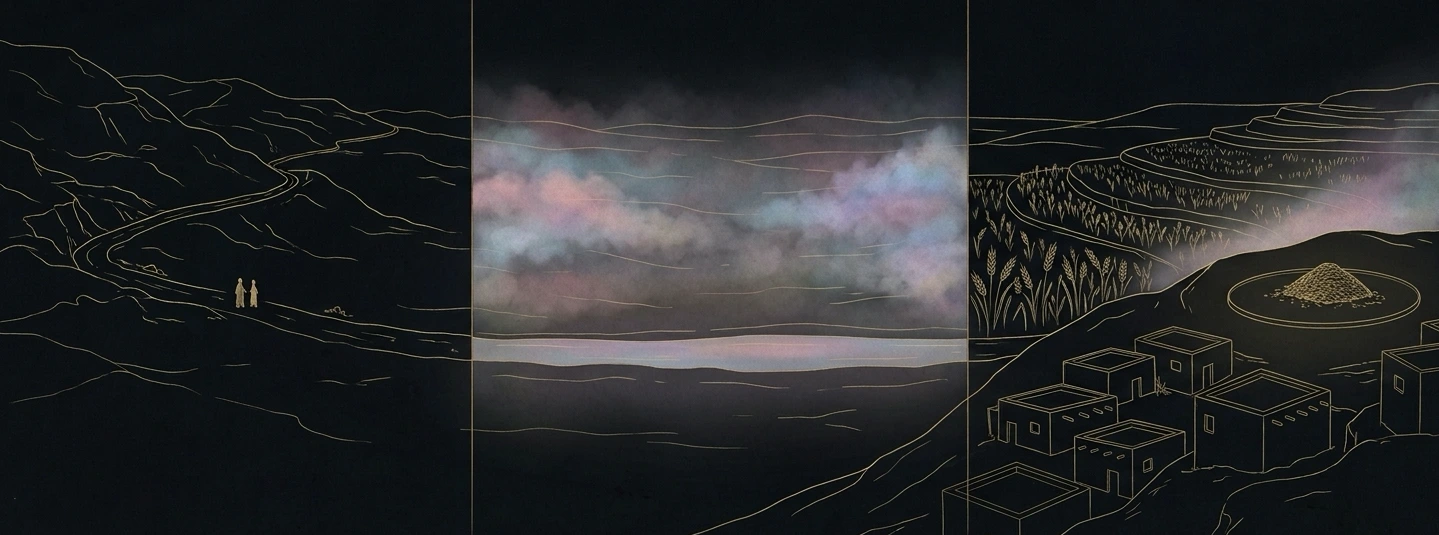
Moab sits across the Dead Sea from Bethlehem, near enough to walk to and foreign enough to matter. It is the neighbour Israel's texts treat worst: Numbers blames Moabite women for leading Israel into worship of another god, and Deuteronomy bars Moabites from the assembly of the LORD to the tenth generation. Going there to eat during a famine is what people did, and the book reports it without a word of comment.
A widow's position was a matter of property law rather than sympathy. Households held land, land passed through men, and a woman with no husband and no sons had no standing and no income of her own. When Naomi tells her daughters-in-law that she has nothing to offer them, she is not being dramatic. She is describing the arrangement accurately. What was left to a woman in that position was a household willing to take her in, or the leftovers of somebody else's harvest.
Those leftovers were legislated. Leviticus and Deuteronomy require a landowner to leave the corners of his field unharvested and to stop going back for what was dropped, and they name who it is for: the poor, the foreigner, the widow, the orphan. It is relief written as a restriction on the strong rather than as generosity from them, which is a different thing, and it depends entirely on the strong obeying it.
The book plays with its names and expects you to notice. Bethlehem is house of bread and has no bread. Naomi is close to the word for pleasant, and she asks the town to call her bitter. The two sons who die are named Mahlon and Chilion, which sound like the words for sickness and for wasting away. Reading the names is part of reading the book.
The first half of this book is survival. A woman comes home with nothing, another woman goes out to work, and the day ends with about thirty pounds of barley and a name that turns out to matter. Nothing has been claimed yet, and nobody has asked anybody for anything.
What follows is a claim being pressed, by two women with no standing, using a piece of family property law that does not quite cover their case. It starts at night on a threshing floor, where the risk is entirely Ruth's, and it finishes in daylight at a town gate, in front of ten elders, in a conversation nobody thinks to include her in.
Movement 2 · Ruth 3–4The redeemerNaomi stops waiting and makes a plan, and Ruth takes it further than the plan went. What follows is a legal claim pressed by people with no standing, and settled at a town gate by men who never think to ask her a question.+
The ground beneath the claimThe situation+
A redeemer, in this law, is a relative with both the right and the duty to buy back what a family has lost: land it was forced to sell, or a relative sold into debt slavery. It is a family safety net written into property law, and it exists because land was not supposed to leave a family permanently. The word runs through the second half of this book and it is a legal term before it is anything else.
There is a separate obligation, in Deuteronomy, that a dead man's brother should marry his widow so that the first son carries the dead man's name and keeps his portion. It applies to brothers living on the same property. Boaz is not a brother, and neither is the nearer man.
What happens in this book is not exactly either law. It combines buying back the land with taking on the widow, in a case neither statute covers, and ten elders at a gate agree to it. Whether the book is describing a custom we have no other record of, or constructing what it thinks the law ought to have said, is genuinely argued. Saying so is more honest than tidying it into a statute that fits.
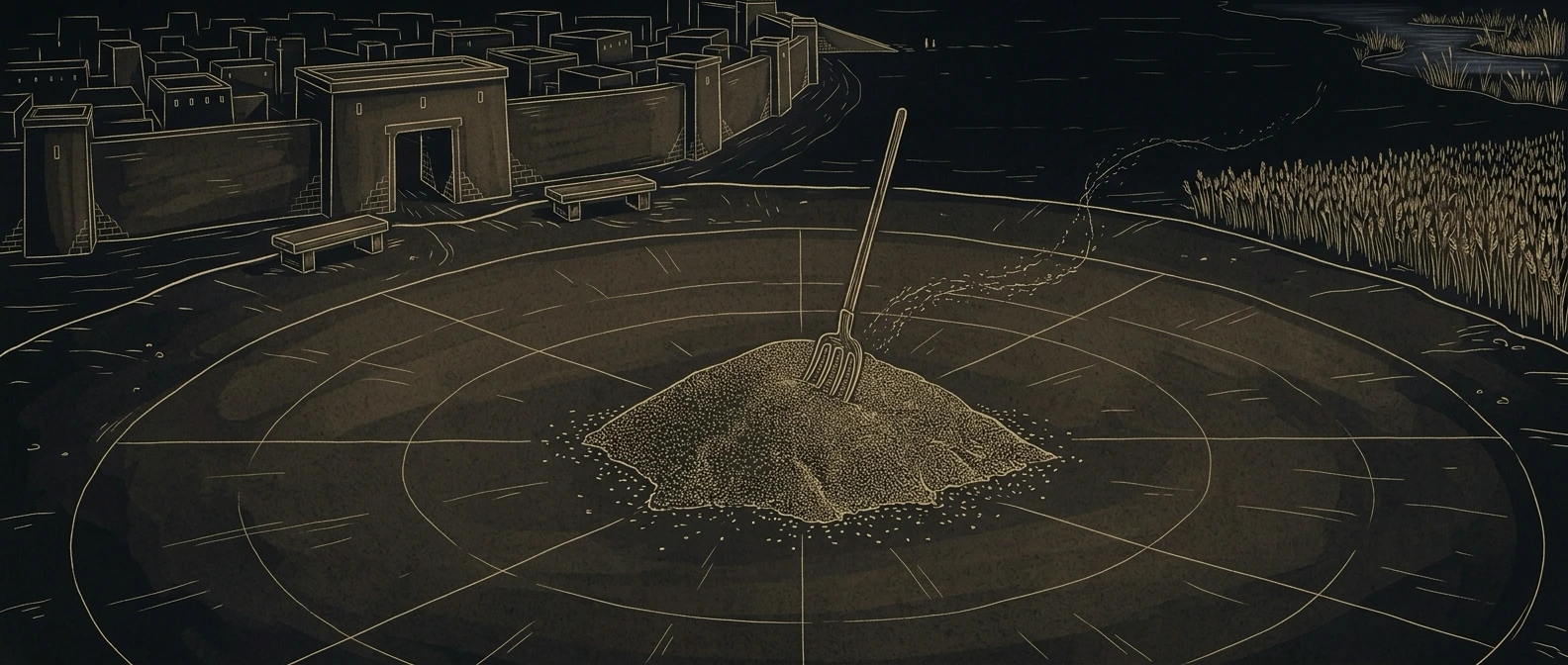
And the threshing floor is a working site, not a house. At the end of harvest the grain is beaten out and thrown into the wind on a hard floor, usually on high ground, and the men sleep beside the heap to guard it. It is at the edge of town, in the open, at night. That is where Naomi sends her.