Mark
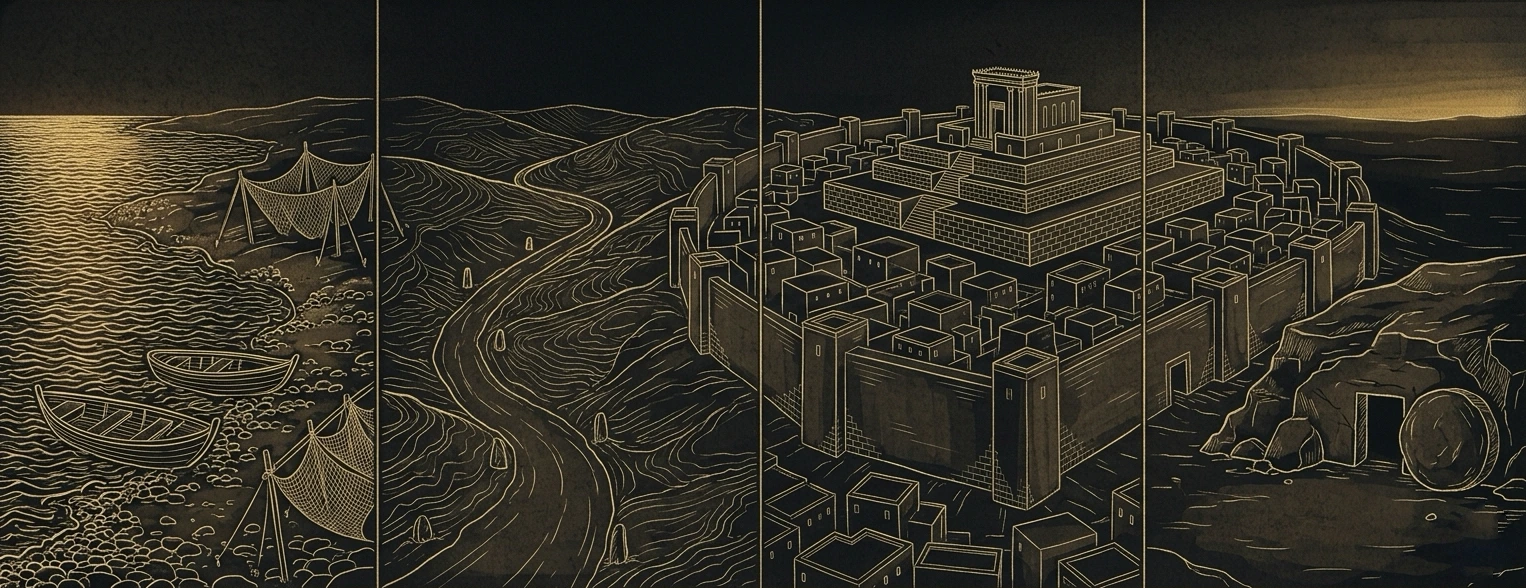
Four movements: the authority, the way, the temple, handed over.
An introduction · Mark 1–16The book that stops mid-sentence+
Mark is the earliest of the four gospels, and the other three knew it. Matthew and Luke both had it in front of them and used most of it, often word for word, which is the plainest reason to read this one first: it is the account the others were working from, before it was tidied. The Greek is rough and urgent, largely in the present tense, and the writer says immediately more than forty times.
It is anonymous. The name comes from a tradition recorded early in the second century, quoted much later by Eusebius, which ties the book to Peter's preaching. The claim is old and it is contested, and nothing in the book itself names its author. What the book does show is its audience: it stops to explain Jewish custom and translates every Aramaic phrase, so it was not written for readers who already knew either.
Then the ending, which almost no reader has had put to them plainly. The two oldest complete copies of this book stop at 16:8, with women running from an empty tomb and telling nobody, because they were afraid. The twelve verses printed after that in most Bibles are a later addition. Some manuscripts carry a different, shorter ending instead, and a few carry both. Five more verse numbers in this book, 7:16, 9:44, 9:46, 11:26 and 15:28, are empty for the same reason: the numbering was fixed before the earliest manuscripts were consulted, and the words in them were never in the earliest copies.
None of that is a scandal being reported. It is in the footnotes of most study Bibles. What is unusual is being shown it while you read rather than after, and being left to notice what it does to the book. An account in which nobody recognises the man it is about, whose closest followers fail at every turn, and whose one clear statement of who he is comes from the officer running his execution, ends by refusing to finish.
- c. 30 CE
- The events as the book arranges them: about a year in Galilee, and one week in Jerusalem.
- 66–70 CE
- The Jewish revolt against Rome, ending with the destruction of the temple.
- c. 65–75 CE
- The window most place the writing in, which is what makes chapter 13 the argument it is.
- Early 100s CE
- The tradition tying the book to Peter's preaching is recorded. It is old, and it is contested.
- c. 80–90 CE
- Matthew and Luke are written, both using this book, both softening its portrait of the disciples.
- 300s CE
- Sinaiticus and Vaticanus, the oldest complete copies. Both stop at 16:8.
Movement 1 · Mark 1:1–8:21The authorityA man arrives with no birth, no childhood and no genealogy, and starts giving orders that things obey. The crowds grow, the authorities decide by chapter three that he has to go, and nobody watching can say what they are looking at.+
The ground beneath GalileeThe situation+
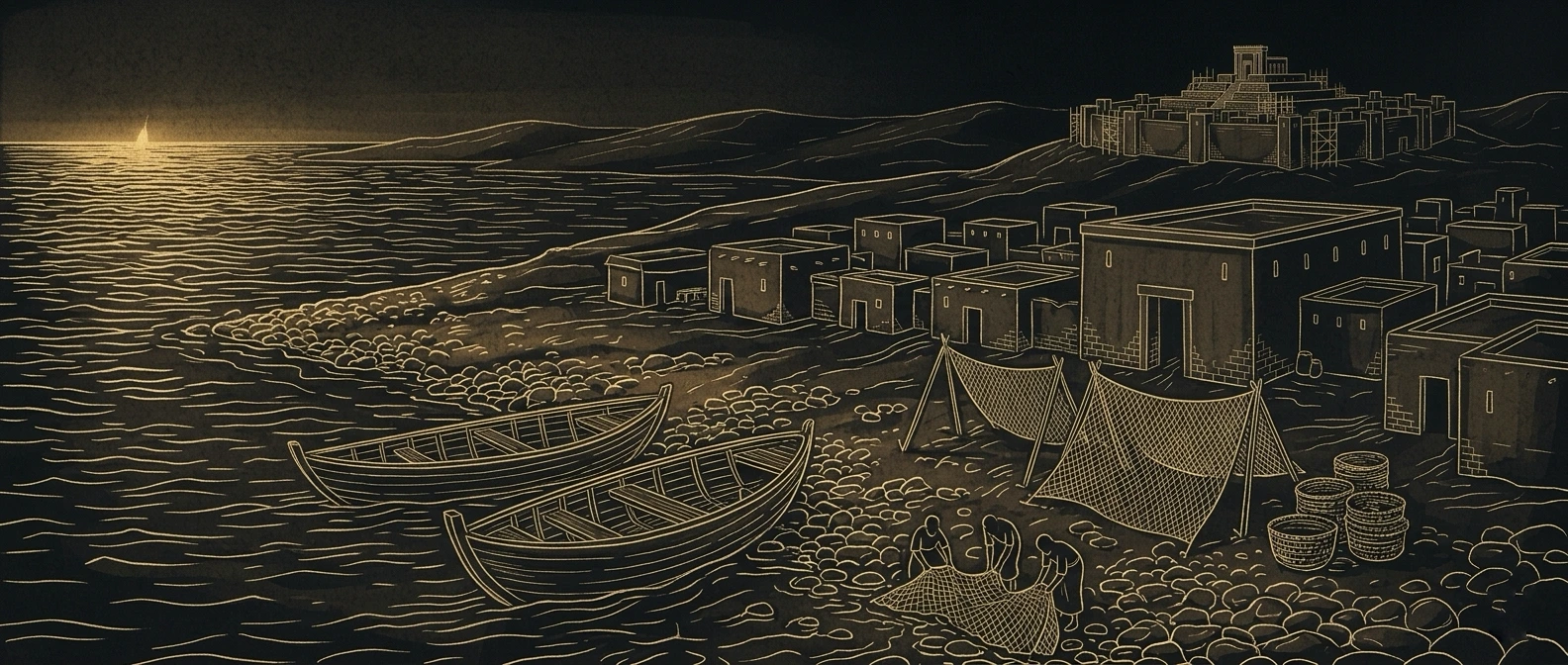
Galilee was not governed from Rome directly. It was run by Herod Antipas, a client ruler who kept his position by keeping Rome satisfied, and who was building two cities, Sepphoris and Tiberias, out of the region's taxes while this story is set. The lake was a working fishery, licensed and taxed, and the collection apparatus of that system is what the book means when it says tax collectors. These are not villains in a morality tale. They are the visible end of an occupation's revenue.
In this world, illness, madness and misfortune were widely understood as something having taken up residence where it did not belong. Reporting that accurately is not the same as endorsing it, and sneering at it makes the book unreadable. It is worth noticing how close the vocabulary of possession runs to the vocabulary of occupation, and that the book was written for people living under one.
It was written for readers outside Judaism. It stops to explain Jewish handwashing custom to an audience that would not have known it, and it translates every Aramaic phrase it uses. The Greek is rough and fast, mostly in the present tense, and it says immediately more than forty times. Nobody has ever mistaken it for literary prose.
And it was written into a war. The window most scholars give runs either side of the Jewish revolt against Rome and the destruction of the temple in 70. Whatever else it is, it is an account of a Galilean executed by the Roman state, written for people who were watching that same state level Jerusalem.
- The beginningMark 1:1–20 · Three scenesNarrative
- A day in CapernaumMark 1:21–45 · Three scenesNarrative
- Five argumentsMark 2:1–3:6 · Four scenesNarrative
- Out of His mindMark 3:7–35 · Three scenesNarrative
- Parables, and the stormMark 4 · Three scenesNarrative
- LegionMark 5 · Three scenesNarrative
- What He could not do thereMark 6 · Four scenesNarrative
- What comes outMark 7 · Three scenesNarrative
- Do you still not understand?Mark 8:1–21 · Two scenesNarrative
Eight chapters of authority end in a question nobody in the boat can answer. What follows does not answer it either, exactly. It changes it.
From here the book has a direction and a destination, and he begins saying out loud what is waiting at the end of the road. Three times. And three times the men walking with him hear something else entirely, because what he is describing is not what any of them came for.
Movement 2 · Mark 8:22–10:52The wayBetween two blind men who are given their sight, he says three times what is coming, and three times the people closest to him hear something else. The book stops asking who he is and starts asking what following him costs.+
The ground beneath the wayThe situation+
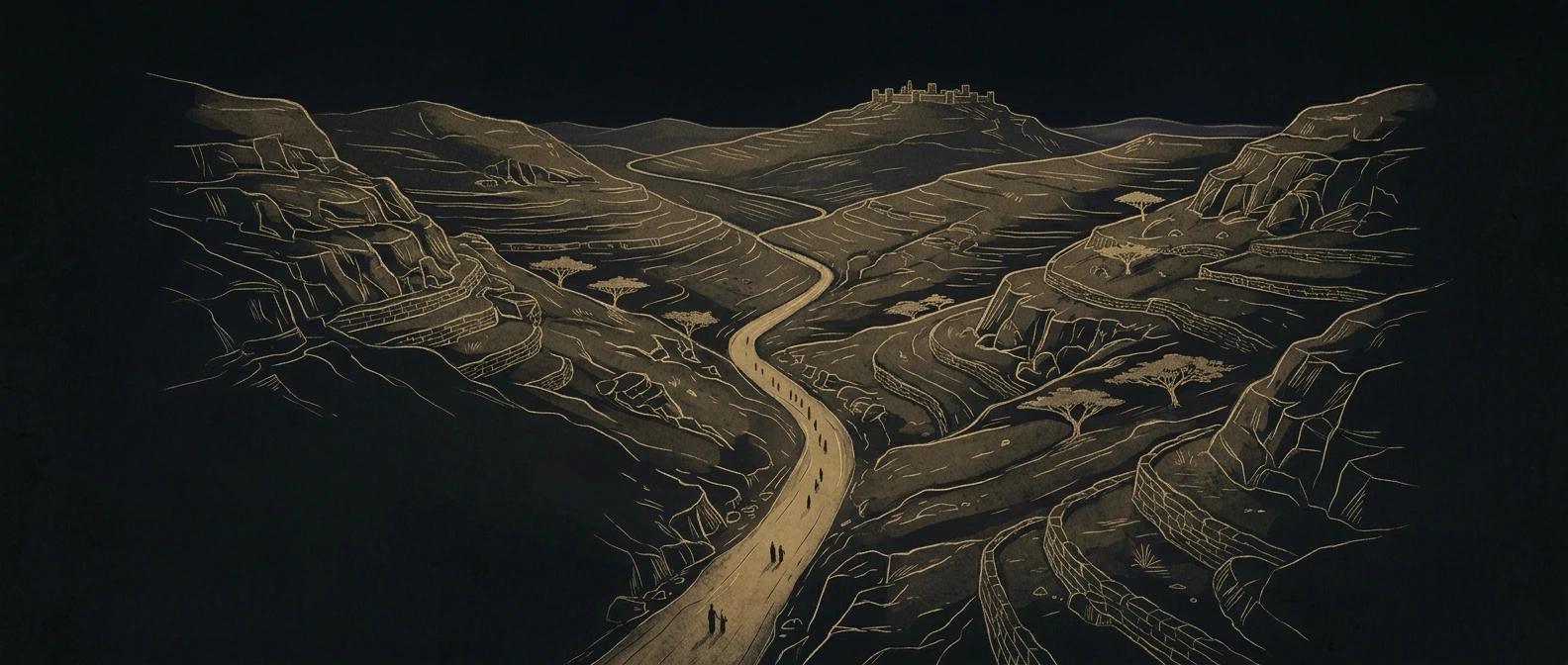
This stretch is bracketed by the only two blind men in the gospel. At Bethsaida, where the healing takes two attempts, and at Jericho, where a man throws off his cloak and follows on the road. Between them, three times, he says plainly what is going to happen to him, and three times the people closest to him hear something else: Peter rebukes him, they argue about who is greatest, and James and John ask for the best seats. Each misunderstanding is followed by teaching about what following actually costs. That is the construction, and most readers have never been shown it.
The road is literal as well as thematic. From Caesarea Philippi in the far north to Jericho is most of the length of the country, and the final stretch climbs from below sea level to around seven hundred and fifty metres. Mark says they were going up to Jerusalem and that he was walking ahead of them, and every reader knew what was waiting at the top.
Son of Man is the title he uses of himself here, and it settles nothing. It can mean simply a human being, and it is also the figure in Daniel 7 who is given dominion. Mark has him use it of the one with authority to forgive sins and of the one who will be handed over and killed, and never explains the gap between them.
The two-stage healing at Bethsaida is the only one in the gospels that takes more than one attempt, and it opens the movement. Whether that is medical realism or literary construction is worth deciding for yourself. The man who sees people as trees walking, and then sees clearly, sits four verses before Peter half-sees who Jesus is and is rebuked for the other half.
- Trees walkingMark 8:22–38 · Three scenesNarrative
- Listen to HimMark 9 · Four scenesNarrative
- One thing you lackMark 10:1–31 · Two scenesNarrative
- On the roadMark 10:32–52 · Two scenesNarrative
The road ends. What has been coming since chapter eight arrives at a city packed for Passover, with a garrison in it and a leadership that has been planning this since chapter three.
Six days, most of them spent arguing in a courtyard. He rides in, shuts the temple down for an afternoon, wins every argument they bring him, and then sits on the hill opposite and says the whole thing is coming down.
Movement 3 · Mark 11–13The templeSix days in Jerusalem. He rides in, shuts the temple down for an afternoon, wins every argument they bring him, and then sits on the hill opposite and says not one stone will be left on another.+
The ground beneath the templeThe situation+
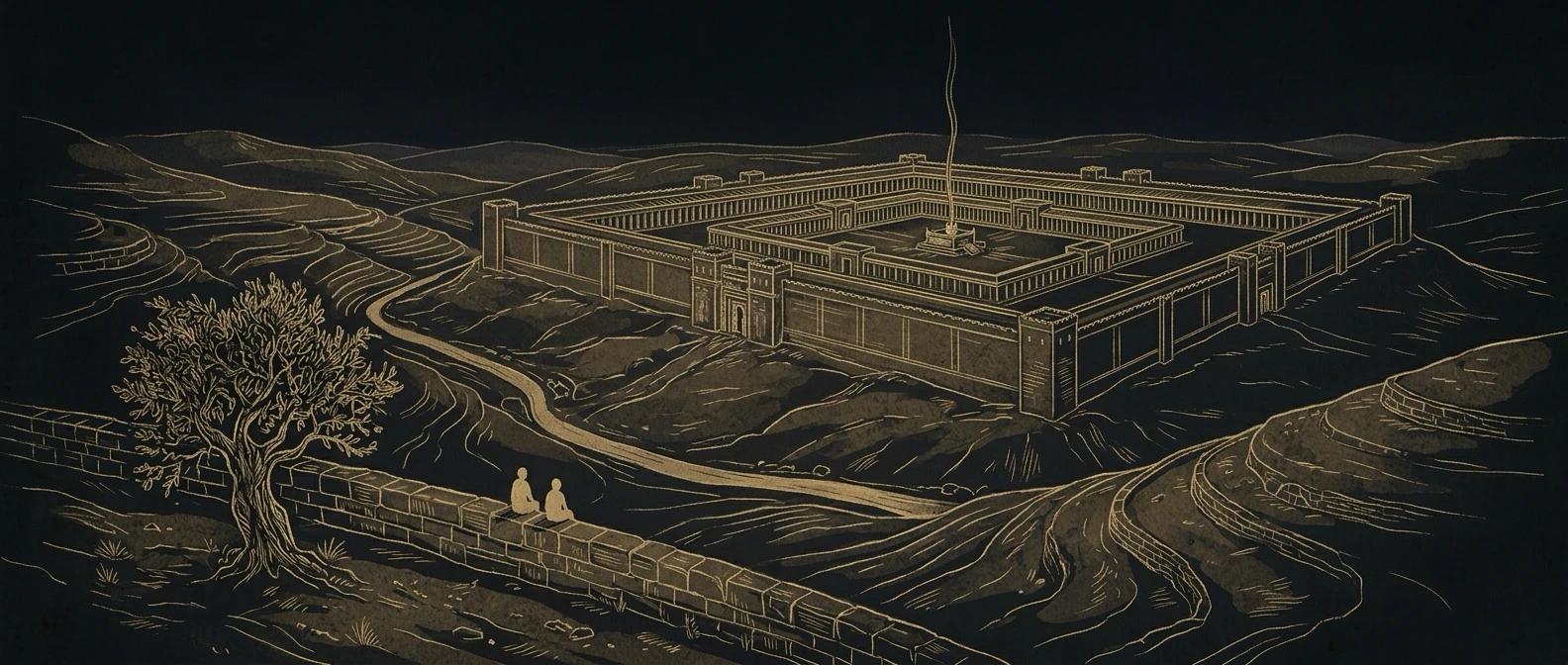
The temple was not a church. It was a working institution, the largest building project in the region, employing thousands, and the centre of a sacrificial economy the law required. Pilgrims arriving for Passover needed unblemished animals and had to pay a temple tax in an acceptable coinage, so the money changing and the animal selling in the outer court were not corruption. They were the mechanism.
Herod's rebuilding of it was still going on within living memory of these events and was finished only a few years before the whole thing was destroyed. The stones a disciple points at in chapter 13 were genuinely enormous, some of them weighing many tons, and pointing at them is what visitors did.
The week matters too. Jerusalem's population multiplied at Passover, a festival commemorating a liberation from an empire, which is precisely why the Roman governor came up from Caesarea with troops for it. That is the room this argument is happening in.
And then the dating problem, which is chapter 13's whole difficulty. Most placings of this gospel put it within a few years either side of 70, the year the temple was destroyed. Whether chapter 13 is prediction, or a text shaped by an event already under way, or both at once, is genuinely argued, and it cannot be settled by preferring one answer.
- Not the season for figsMark 11 · Three scenesNarrative
- The stone the builders rejectedMark 12 · Three scenesNarrative
- Not one stoneMark 13 · Three scenesNarrative
The arguing is finished. What follows is the longest continuous stretch in the gospel, told almost hour by hour, from a woman with a jar to a stone rolled across a door.
The verb running through it is handed over. Judas hands him to the priests, the priests hand him to Pilate, Pilate hands him to the soldiers. Nobody in the chain has to decide very much. Each of them passes him on.
Movement 4 · Mark 14–16:8Handed overA woman pours out oil, a friend sells him, the rest run, and he dies asking why he has been abandoned. The only person who says plainly who he is, is the officer who killed him. Then the book stops.+
The ground beneath the last weekThe situation+
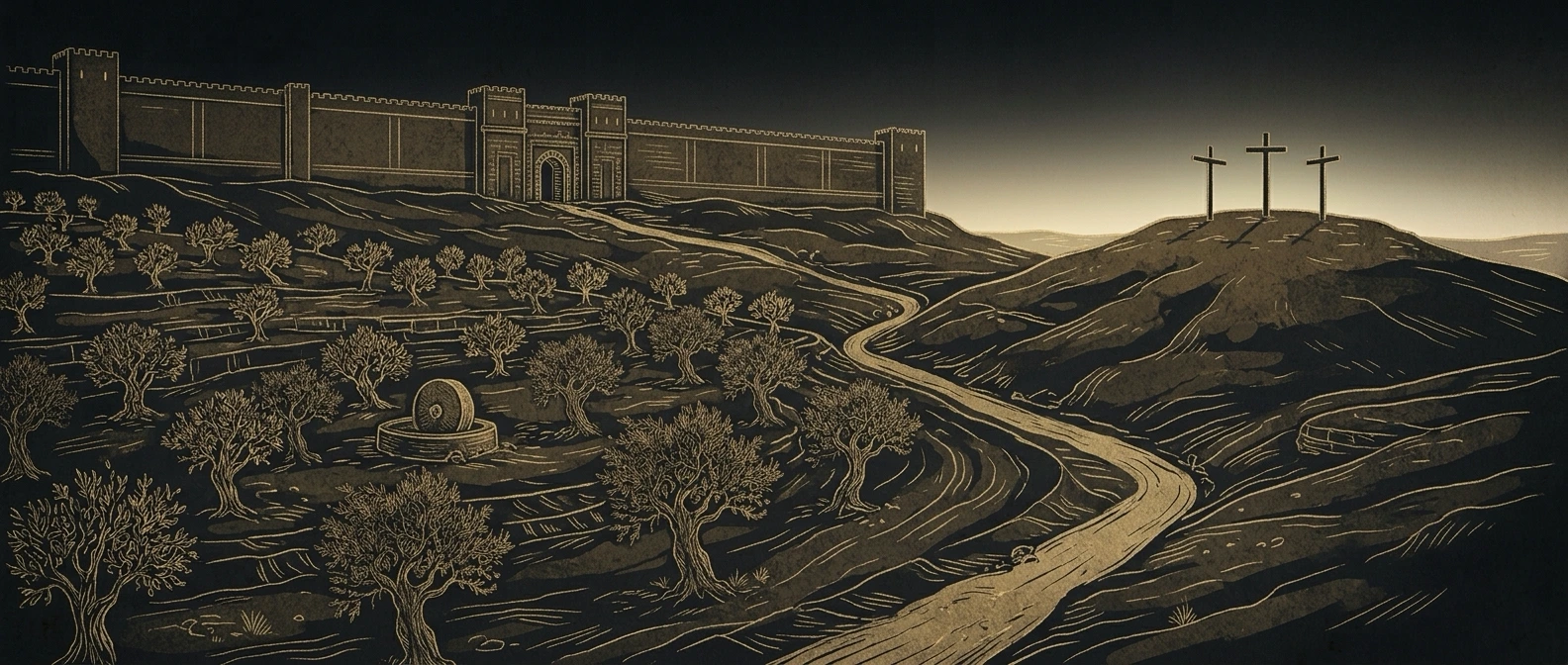
Crucifixion was not primarily a way of killing people, which could be done faster and more cheaply. It was a public deterrent, used by Rome on slaves and on provincials convicted of sedition, carried out beside roads and outside city gates so that it would be seen. The placard naming the charge was part of the mechanism. King of the Jews is a sedition charge, not a theological one.
Judea was governed by a Roman prefect who held the power of execution, which the council did not, which is why there are two hearings rather than one. The council's problem was to produce a charge Rome would act on, and a claim to kingship was the charge that worked.
The week is the reason for the tension in it. Jerusalem's population multiplied at Passover, a festival commemorating liberation from an empire, and the governor came up from Caesarea with troops for exactly that reason. Arresting somebody at night, away from the crowd, is what the text says they were trying to do, and it is what anybody would have done.
And the burial is unusual. Crucified bodies were often left where they were, which was part of the point, so a body released to a member of the council is irregular enough that Mark has Pilate check first whether he is already dead.
- Take this cupMark 14:1–52 · Three scenesNarrative
- Outside in the courtyardMark 14:53–72 · Two scenesNarrative
- Truly this manMark 15 · Three scenesNarrative
- They said nothing to anyoneMark 16:1–8 · One sceneNarrative